Showing posts with label storm surge. Show all posts

Friday, July 13, 2012

Capturing The Story

John Gooding came knocking on my door around 7am.  I had crawled out of bed around 5am to film the morning train come into the station but I had gone back to bed so I was lying half awake, half in my sleeping bag.

"You guys want to go out in the boat today?" John asked.

"Lets do it," I told him.

"I'll be back in 20 minutes after I put gas in the tank."

So I lingered for another 10 minutes, drank some water and got my camera gear ready to go.

The three of us - Ben, John and I - were out in the water within half an hour.  Ben is the associate producer acting as sound engineer.  I'm the cinematographer.  John is our subject.  He was a hero during the response to Katrina and today, he continues to shine a light on the environmental fall out following the deepwater horizon oil spill.

It was a bit crowded on the little outboard whaler boat and water was splashing in over the hull.  I locked my camera gear away in the Pelican case and lamented all the moments I could not capture on video.

"If you want, we can go up river," John offered.  "We don't have to go out to Cat Island today."

I pulled the camera back out when we got to Cat Island.  Birds were diving into the water and eating fish.  Even 50 feet out, we had to be careful about beaching the boat so we couldn't get in very close.  The kit lens on my NEX-VG10 goes out to 200mm but the constant tilt and roll of the boat limited my ability to capture the story unfolding in front of me.

Temperature of 85 degrees.  Mild humidity.  We couldn't have picked a better day to go out to the island.
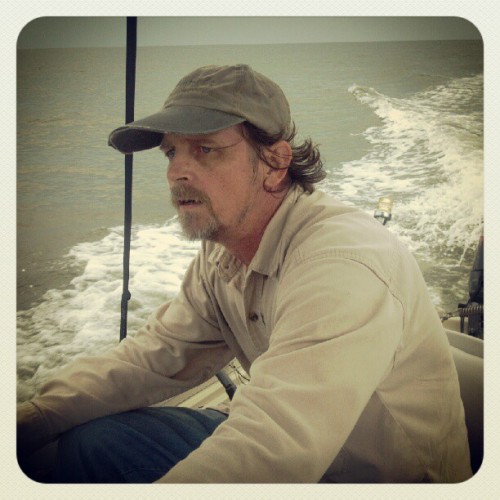

I put the polarizer and UV filters on and did my best to keep up.  As we pulled the boat on shore, John jumped out to look for tar logs.  He'd run out ahead of us pretty far and I wore myself out trying to stay ahead of him.

In response to the oil spill, BP dumped millions of gallons of neurotic dispersant to mitigate the disaster.  According to BP, the problem is all fixed.  According to others, like John Gooding, the oil is still out there and continues to wash ashore in the form of tar logs.  Little globs of tar and sand - roughly the size of a 40oz can of malt liquor.

John was picking everything up and smelling it.  Little black logs.  Most of the time it was charred organic material like burned logs.  Sometimes it was a tar log.  We also found a hunk of brown sticky rubbery god-knows-what.

Right as we were getting ready to leave for home, we saw storm clouds brewing on the horizon.  Specifically, storm clouds blocking our path back to the mainland.  We decided it was better to wait out the storm on land than to meet it in open water so we stayed put.

We watched as waterspouts dip down from the sky.  Fortunately, the lightening broke or we would have been more anxious about sitting in the path of the storm.  And as it approached, we could see the storm front as physical as a locomotive, barreling down on us.  I filmed for as long as I felt comfortable and then I put the camera back into the case.

Birds went crazy.  Bugs went nuts.  Our sunny day was quickly obscured by the clouds rolling in.  The wind picked up and tossed pellets of rain and saltwater into our eyes.  And I didn't get any of it on film.

After the storm passed we noticed the tide was beginning to change and that our boat was now high in the sand.  So there was that to deal with.  Racing against time, we got to pushing the boat back to the water.  We were soaked up through the soles of our shoes and as the sun came back out the wind dried our shirts and left chunks of sand on our skin and in our hair.

It pains me as a documentary filmmaker to sit back and let these experiences happen to me - especially the emotionally intense moments  - but perhaps it is important to let some of these moments go.  With my eyes free from the frames of the picture, I am able to see the bigger story.

That is, how people meet the challenges life presents to them if that be literal storms or the metaphorical storms of the human condition.

The next day, as John worked on his boat engines, the story manifested itself to me again.  He was trouble shooting an engine that wouldn't start.  He said when engines sit for a long time, the gasoline turns to varnish and blocks the fuel from igniting properly.  The puzzle was in finding the buildup and flushing it out.

With him today, John brought his daughter and his Slavic son-in-law to hand him screws and generally learn everything he knows about boat maintenance.

"Its useless.  This engine is not going to start," John's son-in-law declared.
Well, five minutes later he had it started.  And I captured the moment.  Where other people are quick to give up, John Gooding stays with his problems until he sees that they are fixed.  Its an admirable trait.  And its an incredible feeling, as a cinematographer, to find that trait that really defines a person and to capture it in pictures.  Its incredibly rewarding.

Sunday, June 10, 2012

From Tommy To Tornados

I am exhausted but I am still awake. My camera and computer gear is sprawled out across a dining room table. A dim lamp sits in the corner. Listening to My Bloody Valentine. I'm processing raw video files. We are mid-production on Storm Surge. A documentary film about communities rebuilding after natural disaster.

This is my first meaningful documentary film since my first effort, Tommy Dean & Friends.

I'm wondering how we're going to piece this film together. I'm wondering how this new project fits in with my personal development as a filmmaker. And I'm totally anxious about where this going to take me into the future.

The Tommy Dean film were somewhat high concept films. They were about Tommy Dean, the singer songwriter. As a character driven meditation on a theme, the narrative was free to jump back and forth and spiral out of control. Each scene revealed a new aspect of Tommy's world and the film held your interest for as long as you were interested in that special world I had to share with you.

Storm Surge is a different kind of film because we have important information we want to convey. First, we have the stories of survival. Personal testimonies of surviving natural disaster. Then we have the social and economical issue of disaster preparedness. We look at what people to do protect their families. And third, we have a call to action, inviting individuals to get involved with their communities in building something new.

Survival, resiliency and recovery.

I'm starting to wonder in what ways is Storm Surge also a high concept film. Is it about storms or is it about communities? Its about how storms shape communities. Storms can take the form of the literal natural disaster: a hurricane or tornado. Or in a more broad sense, a storm can be a man made disaster: oil spills. And in the most abstract sense, we can interpret storms as the clash of communities themselves: industry, capitalism, politics, religion, whatever, ect... everything breathing in and out and communing with the creative and destructive powers that be.

And like the Tommy Dean film, music is going to be the glue that keeps it together. More than that, music is the TARDIS that enables the narrative to jump from emergency responders to social media mavens to political figures to survivors.

This film is going to be a total psychic blast. A spiritual journey. And a tome to the human spirit. All that happy stuff.

Sunday, May 27, 2012

Hard Drives and Internet

I'm on the road right now. In Joplin, MO and talking to people about the community rebuilding efforts since the tornado that came through the town last year. It's been a total consciousness shifting experience. One big thing that I wish we had more of was hard drive space and internet connection. I am shooting an easy 30GB every day. Maybe half of my footage is backed up in two places and half of it is sitting precariously on only one hard drive. Following conventional wisdom of file storage, I don't have any footage yet. This drive could fail at any time and I would be fucked. Not an unlikely scenario for a dude who is currently camping in a tent.

We've been tossing around the idea of picking up a wireless modem. We would like to either upload our archived footage to the cloud or shoot the footage directly to our editors using bit-torrent.
We've been spending a lot of time at Starbucks.  I've been making the mistake of asking about natural beef at sports bars.   I've been struggling to drink enough water.  And I think I've seen more variety of bugs on this trip than I have in my entire life.  More on that later.

Jesus is so prevalent in all corners of life here.  There was a bible reading from The Book Of Job at the high school.  A middle school principal shared with us her experience in witnessing the hand of god comforting people through these hard times.  Many people recount stories about white butterflies or angels in black suits literally guiding people to safety.  To these people, the personal relationship with Christ is not an abstract or intellectual thing.  Its real.  They feel it almost on a primal level.  More on that later.

Wednesday, June 8, 2011

Storm Surge


I met Stacy of Moontown Foundation late last summer immediately after his return from the Gulf Coast where he collected personal testimonials of Katrina and oil spill survivors. He contacted me, the journalist filmmaker, because he wants to go back to the Gulf Coast, to capture their stories and produce a documentary film.

That film project is Storm Surge.

Our goal is to push through the immediacy of tragic events as fragmented news stubs and look at the bigger picture. We want to shake up everything you think you know about The South, their relationship with big oil, their feelings about the environment and their plans to rebuild. Most of all, Storm Surge is a testament to the importance of individual action in one of the greatest social, economic and environmental tragedies of our time.


Stacy's plan is to bring a multidisciplinary team of college students from the science and engineering schools to evaluate the environmental capital and socio-economic feasibility of launching sustainable business opportunities. Natural resources have been destroyed, homes were lost and several core industries may not ever recover from the oil spill. Not within our lifetime. So the question we are asking is, what comes next?